Imagine walking down Duval Street and finding boarded-up storefronts, neglected Victorian homes and businesses struggling to survive.
It’s difficult to picture the Key West we know and love looking anything like that. But just a few decades ago, the island was searching for a new economic identity.
Then something remarkable happened.
People began arriving who looked at those neglected historic buildings and saw something others had overlooked: opportunity.
Two of those people discovered an old apartment complex, a former cigar factory and a laundromat on the corner of Fleming and White Streets.
What they created would become part of a much larger transformation.
Today, you’ll find Island House Resort at that corner, along with Historic Marker #69. But the history of Island House Key West is about much more than a place to spend the night.
It’s a story of military history, a changing island landscape, entrepreneurship, historic preservation and the LGBTQ+ community’s significant contributions to the Key West we know today.
🎧 Prefer to listen? Join me on the Fun in Key West podcast as we uncover the fascinating story behind Island House and Key West’s tourism renaissance.
Three Historic Buildings With Very Different Stories
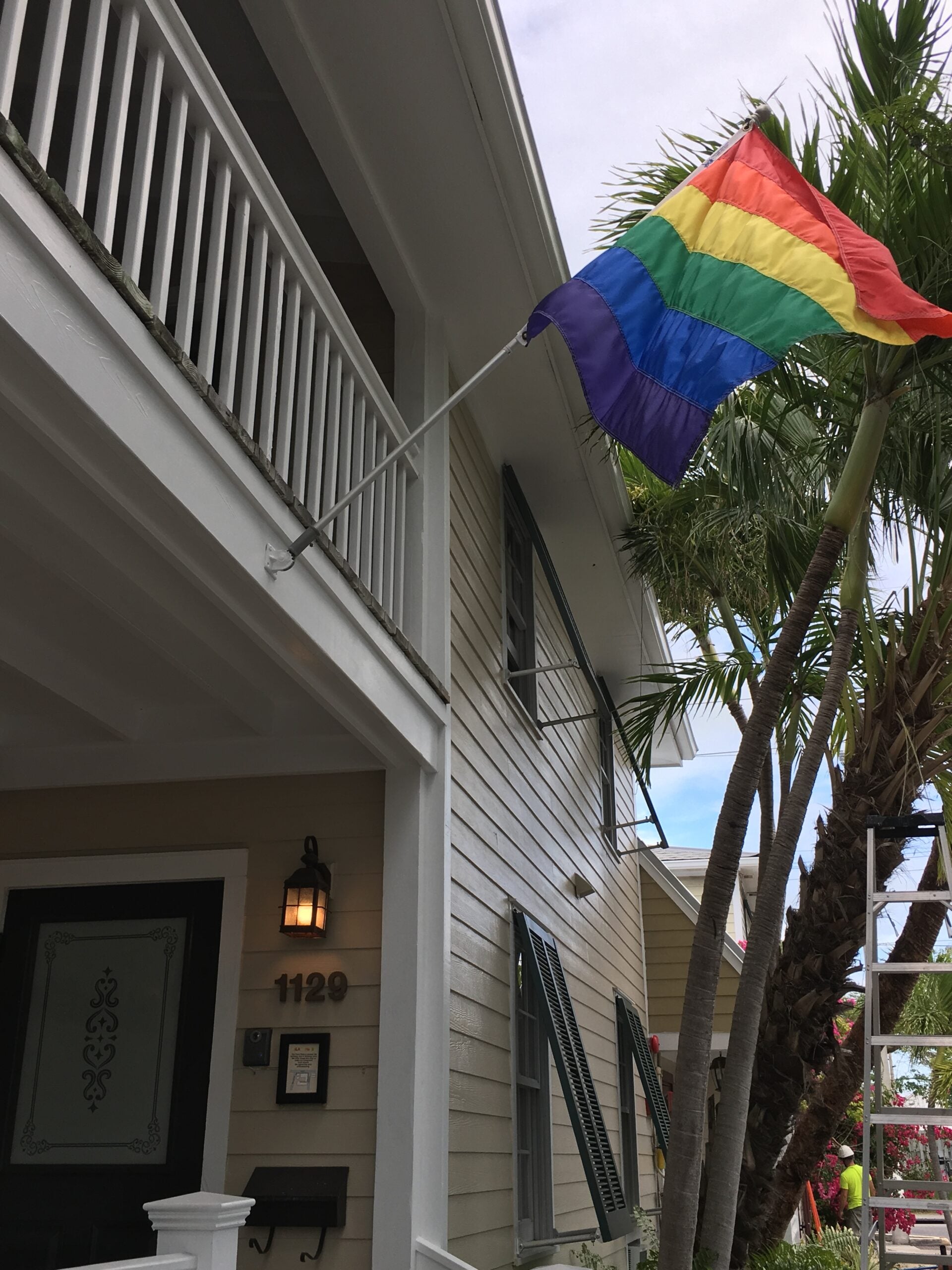
Island House, located at 1129 Fleming Street, is actually a collection of three historic buildings.
According to Historic Marker #69, the buildings are believed to date to approximately the 1920s, although one of the resort’s original owners recalled that part of the property dated to 1895.
Two of the buildings contained apartments that accommodated military families living off base.
The third building, which now serves as the resort’s entrance, originally operated as a small cigar factory.
By the 1960s, the former cigar factory had been converted into a laundromat.
From rolling cigars to washing clothes to checking in vacationers, these buildings certainly have experienced their share of career changes!
Interestingly, the historical marker also suggests that two of the buildings may have originally stood across the street on military property before being relocated to make room for expansion.
While their relocation hasn’t been definitively established, moving wooden buildings was not unusual in historic Key West.
To understand why these buildings might have been moved, we need to explore the history of the property across White Street.
The Key West Army Barracks: When Peary Court Had a Waterfront View
If you’ve traveled along White Street, you’ve probably passed the residential community known as Peary Court.
But did you know this property was once home to an important military installation?
Construction of the Key West Army Barracks began in 1835. The approximately 25-acre property was strategically located to accommodate military personnel and support the island’s defenses.
Key West’s location near important maritime shipping routes made it particularly valuable to the United States military.
Over the years, the barracks experienced periods of expansion and decline as military operations changed.
But here’s the part I find especially fascinating.
The northern side of the barracks, near present-day Palm Avenue, once bordered the water.
That’s right. The Army barracks once had waterfront property.
So, what happened to the waterfront?
Enter Henry Flagler.
How Henry Flagler Literally Changed the Shape of Key West
When we think of Henry Flagler, we generally think of the remarkable railroad that once connected mainland Florida to Key West.
But bringing the railroad to the island involved much more than constructing tracks and bridges.
Flagler needed space for his railroad terminal and related operations. On a small island where available land was limited, that presented a challenge.
The solution was to create more land.
Dredging and filling operations transformed Key West’s northern shoreline, creating additional land for railroad facilities and changing the island’s geography.
According to the Peary Court historical marker, approximately 340 acres were added to Key West during this process.
As a result, the Army barracks lost their direct waterfront access.
Think about that the next time you’re traveling along Palm Avenue. The landscape you’re looking at today is considerably different from what military personnel would have seen during the nineteenth century.
Flagler didn’t simply bring a railroad to Key West.
His project literally changed the shape of the island.
Following World War II, the Navy acquired the former Army property for military housing. It eventually became known as Peary Court, named in honor of naval officer and Arctic explorer Robert Peary.
Meanwhile, across White Street, the buildings that would eventually become Island House continued to serve the needs of local residents.
When Key West Was Searching for Its Future
It’s easy to assume that Key West has always been a thriving tourist destination.
But tourism wasn’t always the island’s primary economic engine.
Throughout its history, Key West experienced periods of prosperity associated with industries such as:
- Shipwreck salvage
- Sponging
- Cigar manufacturing
- Commercial fishing
- Military operations
- Railroad transportation
Unfortunately, when those industries declined, the island often experienced significant economic challenges.
In 1934, during the Great Depression, Key West declared bankruptcy.
World War II brought renewed economic activity as the island’s military importance increased. However, reductions in military operations during the decades that followed once again left Key West searching for its economic identity.
By the 1970s, portions of the historic district had fallen into disrepair.
Many beautiful old homes needed extensive renovations. Businesses struggled, and parts of Duval Street looked considerably different from the lively destination we know today.
It’s almost impossible to imagine walking down Duval Street and seeing boarded-up storefronts instead of bustling restaurants, shops and bars.
But that was part of the island’s reality.
Fortunately, there were people who recognized that Key West’s greatest asset might be the very thing others were overlooking.
Its character.
How the LGBTQ+ Community Helped Preserve Key West
During the 1950s and 1960s, many American cities pursued modernization projects that resulted in the demolition of historic buildings and entire neighborhoods.
Key West was largely spared from that widespread redevelopment.
Although economic challenges had left many of its historic properties neglected, much of the original architecture remained.
Local preservation efforts were already underway by 1960, when the Old Island Restoration Foundation was established to protect Key West’s architectural heritage.
During the following decades, members of the LGBTQ+ community became increasingly important participants in the island’s preservation and revitalization.
Key West’s subtropical climate, artistic community, distinctive architecture and reputation for individuality attracted people looking for a place where they could live more openly.
Many purchased aging homes and restored them.
Others established restaurants, galleries, shops, guesthouses and other businesses.
Their investments helped breathe new life into neighborhoods that had experienced years of economic uncertainty.
The beautiful Victorian homes, colorful cottages, intricate gingerbread trim and inviting porches that visitors love photographing today owe their survival, in part, to these preservation efforts.
Rather than replacing Key West’s historic character with something entirely new, many of these entrepreneurs recognized the value of what was already there.
Island House is a wonderful example of that philosophy.
The Dog Walk That Inspired Island House
Some of my favorite historical stories are the ones that begin with something completely ordinary.
And the story of Island House begins with a dog walk.
In a 2024 interview published by OutClique, original Island House owner James Camp shared his recollections of how the resort came to be.
Camp and his partner, Jim Stokes, had previously been involved in another Key West hotel. After selling their interest in that business, they purchased a home on Fleming Street.
One evening, while walking their dog, they noticed a property for sale.
It was known as Paul’s Apartments.
According to Camp, the property included an older residence and sixteen apartments.
Stokes was an architect, and the couple had experience developing properties. They recognized the potential to transform the aging apartment complex into a guesthouse catering to gay travelers.
Most of us take the dog for a walk and come home with a little exercise.
These two came home with the beginnings of a business that would become part of Key West history.
From Laundromat to Island House Resort
Island House opened in 1976.
Converting three existing buildings into a resort wasn’t necessarily a simple undertaking.
In the same OutClique article, early Island House manager Michael Frangella recalled the large commercial dryers that remained from the property’s days as a laundromat.
He also remembered Jim Stokes personally constructing the deck around the swimming pool.
Some residents continued living in portions of the property as the transformation took place.
Rather than demolishing the buildings and constructing an entirely new resort, Camp and Stokes worked with what already existed.
Today, this approach is known as adaptive reuse.
What Is Adaptive Reuse?
Adaptive reuse involves repurposing an existing building for a new function while retaining significant elements of its original structure or character.
It allows buildings that have outlived their original purpose to remain useful rather than being abandoned or demolished.
Key West is filled with examples of adaptive reuse.
Former residences have become restaurants and guesthouses. Commercial buildings have found new lives as shops, museums and entertainment venues.
And in the case of Island House, military apartments, a cigar factory and a laundromat were transformed into a resort.
It’s one of the reasons exploring Key West is so interesting.
The building you’re standing inside today might have served an entirely different purpose a hundred years ago.
Why Island House Was More Than Just a Guesthouse
To understand the significance of Island House opening in 1976, it’s important to consider what travel was like for gay Americans during that period.
Many LGBTQ+ individuals experienced discrimination in their workplaces, communities and personal lives.
Finding a vacation destination where they could feel comfortable being themselves wasn’t something everyone could take for granted.
Guesthouses such as Island House offered more than accommodations.
They offered a sense of community and belonging.
In those early years, the resort’s reputation grew largely through word of mouth, personal recommendations and travel agents.
There were no online booking platforms, social media campaigns or travel influencers sharing videos of their experiences.
Reservations were sometimes confirmed through typed correspondence sent through the mail.
Imagine waiting for your Key West hotel reservation confirmation to arrive in your mailbox!
Through these personal connections, Key West continued developing its reputation as a welcoming LGBTQ+ travel destination.
And the island’s business owners soon recognized that working together could help strengthen that reputation.
The Island House Connection to the Key West Business Guild
In 1978, just two years after Island House opened, the Key West Business Guild was established.
The organization was created to support the island’s gay and lesbian residents, business owners and visitors.
According to James Camp’s recollections, he hosted an early organizational meeting of local business owners.
Camp went on to become the guild’s first president.
The establishment of the Key West Business Guild was an important milestone in the island’s tourism development and LGBTQ+ history.
By working together, businesses could promote Key West as a welcoming destination, support one another and encourage visitors to discover the island.
Today, the Key West Business Guild continues to promote LGBTQ+ tourism and support the local business community.
But another important development was just around the corner.
And it involved throwing a rather large party.
Did You Know Fantasy Fest Began as an Economic Development Idea?
Today, Fantasy Fest is one of Key West’s most recognizable annual events.
But its origins weren’t simply about costumes, elaborate floats and celebrations.
In 1979, local business owners were looking for a way to attract visitors during the traditionally quiet month of October.
Their solution was a festival celebrating the island’s creativity, individuality and colorful personality.
The first Fantasy Fest parade featured 26 floats and attracted an estimated 10,000 spectators, according to historical accounts from the Florida Keys History Center.
What began as an effort to generate business during a slow tourism period eventually became one of Key West’s signature celebrations.
Consider how much changed on the island within just a few years.
- In 1976, Island House opened.
- In 1978, the Key West Business Guild was established.
- In 1979, the first Fantasy Fest took place.
Historic buildings were finding new purposes. Independent businesses were opening. Tourism was becoming increasingly important to the island’s economy.
Key West wasn’t simply recovering from economic challenges.
It was reinventing itself.
You can learn more about the festival at the official Fantasy Fest website.
Fifty Years of Island House Key West
Island House continued to evolve following its opening in 1976.
James Camp and Jim Stokes sold the property in 1989.
A decade later, in 1999, Jon Allen and Martin Kay purchased the resort and undertook extensive renovations, creating a more upscale guest experience.
Today, Island House operates as an adults-only, clothing-optional resort catering to gay, bisexual, queer and transgender men.
The property describes itself as the world’s oldest operating gay men’s resort.
In 2026, Island House reached its 50-year milestone.
That’s half a century of welcoming visitors to Key West.
Of course, the history of the buildings themselves stretches back much farther.
Military families once called portions of the property home. Cigar workers earned their living there. Local residents brought their laundry there.
And two entrepreneurs recognized that those old buildings still had another chapter waiting to be written.
You can explore the property’s accommodations and amenities on the official Island House Key West website.
Where Is Historic Marker #69 in Key West?
You’ll find Historic Marker #69 at Island House Resort:
Island House Key West
1129 Fleming Street
Key West, Florida 33040
The property is located at the corner of Fleming and White Streets, across from Peary Court.
If you’re exploring Key West’s historic neighborhoods, this area offers a wonderful opportunity to look beyond the more familiar attractions along Duval Street.
The surrounding streets feature beautiful historic homes, traditional island architecture and reminders of Key West’s military past.
You can view the historic marker from the exterior of the property. Island House is a private resort, so please respect the privacy of its guests.
Frequently Asked Questions About Island House Key West
When did Island House Key West open?
Island House opened in 1976 after three historic buildings were converted into accommodations for gay travelers. It reached its 50-year anniversary in 2026.
What was Island House before it became a resort?
The property consisted of residential apartment buildings associated with off-base military housing and a former cigar factory that later operated as a laundromat.
Who founded Island House Key West?
James Camp and his partner, architect Jim Stokes, established Island House after purchasing the property previously known as Paul’s Apartments.
Is Island House the oldest gay resort in Key West?
Island House is identified by Historic Marker #69 as Key West’s oldest gay resort. The property also describes itself as the world’s oldest operating gay men’s resort.
What is Peary Court in Key West?
Peary Court is a residential community located on former military property. Construction of the original Key West Army Barracks began in 1835, and the property was later acquired by the Navy for military housing.
How did the LGBTQ+ community contribute to Key West’s historic preservation?
Many LGBTQ+ residents and entrepreneurs purchased, restored and repurposed historic properties, opened businesses and helped establish Key West as a welcoming tourism destination. Their efforts complemented those of established preservation organizations and other island residents.
Why was Fantasy Fest originally created?
Fantasy Fest began in 1979 as an effort by local business owners to attract visitors during the traditionally slow month of October. It grew into one of the island’s most recognizable annual celebrations.
What Makes Key West, Key West?
While researching the history of Island House, I kept thinking about how easily Key West could have become a very different place.
What if those historic homes had been demolished rather than restored?
What if the old guesthouses had been replaced by large, uniform hotel developments?
What if nobody had recognized the potential hiding behind those weathered front doors?
Would Key West still feel the way it does today?
One of the things I love most about the island is that it doesn’t feel interchangeable with other vacation destinations.
Every neighborhood has its own personality.
Every building seems to have a story.
And the island’s individuality is something generations of residents, preservationists and entrepreneurs have worked to protect.
The LGBTQ+ community’s contributions deserve an important place in that story, not simply because they helped develop tourism, but because they helped preserve many of the things that make Key West worth visiting.
Sometimes, preserving history doesn’t mean turning a building into a museum.
Sometimes, it means allowing that building to become something different while keeping its story alive.
And sometimes, the best thing you can do for an old place is give it a second chance.
So, the next time you’re walking along Fleming Street, stop for a moment at Historic Marker #69.
Look at those three buildings and consider all the lives they’ve lived.
They’re a reminder that Key West’s greatest stories aren’t always found in its most famous landmarks.
Sometimes, they’re waiting on a quiet street corner.
What’s the one thing about Key West that you hope never changes?
The historic architecture? The independent businesses? The colorful personalities? Or that feeling of freedom you experience when you finally reach the end of the road?
I’d love to hear your thoughts.
Until then, keep exploring and stay curious. There’s always another story waiting around the corner in Key West.