

When most people hear Mel Fisher Maritime Museum, they immediately think of treasure.
Gold. Silver. Shipwrecks. The Atocha. Mel Fisher’s famous “Today’s the day.”
And honestly, that makes sense.
But the next time you walk past the museum at 200 Greene Street, take a second to look at the building itself.
Because before it held Spanish treasure, shipwreck artifacts and maritime history, it had a very different job.
The building that houses the Mel Fisher Maritime Museum was originally constructed by the United States Navy, and its story gives us a fascinating glimpse into a time when Key West was a working military and commercial port powered by steamships, coal and an ever-changing waterfront.
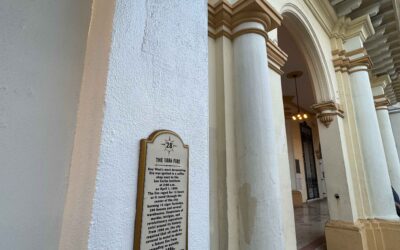
Historic Marker #64
Historic Marker #64 is located at 200 Greene Street, between Whitehead and Front Streets, right at the edge of Truman Annex.
Today, the building is best known as the Mel Fisher Maritime Museum.
But in the early 1900s, this part of Key West looked very different.
The Navy began planning the structure in 1902. Construction started in 1908, and the Naval Storehouse was completed in 1910.
It was officially used as a Storehouse for Supplies and Accounts.
That may not sound especially glamorous, but this was an important building in an important location.
Key West’s position between the Gulf of Mexico, the Atlantic Ocean, Cuba and major shipping routes made it strategically valuable to the United States Navy.
Ships needed supplies.
Crews needed supplies.
And the naval station needed a substantial place to store everything required to keep operations moving.
Key West Was a Working Waterfront
It can be difficult to picture today.
We know this area for Mallory Square sunsets, cruise ships, historic buildings and people wandering toward Duval Street.
But a century ago, this was a busy working waterfront.
The shoreline was different.
Mallory Square did not yet have the configuration we recognize today.
Even the nearby Custom House sat much closer to the active waterfront.
Instead of tourists holding frozen drinks, you would have seen sailors, supply ships, storage areas, cargo and constant activity.
This was a place of work.
And a lot of that work was tied to steam power.
Why Coal Mattered So Much
Steam-powered ships depended on coal.
Lots of coal.
Before diesel and modern marine fuel became standard, access to reliable coal supplies could determine how quickly and efficiently naval vessels moved around the world.
So ports like Key West needed substantial coal storage.
Coal was stored in large bins near the shoreline and moved on and off ships by crews doing incredibly hard physical labor.
Eventually, mechanical conveyor systems were used to help move coal directly toward waiting ships.
Historic accounts of the Naval Storehouse describe part of the building as having been intended or adapted for coal storage.
That actually makes a lot of sense when you look at the role this section of Key West played at the time.
There was just one problem.
Technology was changing.
Not long after the building was completed, naval fleets were increasingly moving away from coal and toward oil and diesel fuel.
So the building may have been ready for an important role just as that role was beginning to disappear.
History has a sense of timing.
A Building Designed to Last
One of the most interesting things about the old Naval Storehouse is the way it was constructed.
The building has a steel frame, which was especially significant for the early 1900s.
The construction contract went to the Penn Bridge Company of Beaver Falls, Pennsylvania, a company experienced in building bridges, iron structures and other heavy-duty projects.
That expertise mattered.
This was not a flimsy warehouse.
It was built to support substantial weight and constant use.
And more than a century later, that strength still matters.
The Mel Fisher Maritime Museum uses the building not only for exhibits, but also for the conservation and preservation of large maritime artifacts.
Some recovered artifacts weigh thousands of pounds.
The building can also support large water tanks used during archaeological conservation work.
In other words, the Navy built a structure strong enough to support supplies and heavy materials.
More than 100 years later, it is still doing essentially the same thing.
Just with cannons, shipwreck artifacts and archaeological finds instead of Navy supplies.
From Naval Storehouse to Mel Fisher
By the late 20th century, the role of the property changed again.
After military cutbacks following the Vietnam War, parts of the historic naval station were transferred into federal control.
Then, in the early 1980s, Mel Fisher needed space.
His salvage operation was growing, and this old Navy building provided exactly the kind of large, durable workspace his team needed.
Fisher leased the Naval Storehouse from the federal government and used it as part of his commercial salvage operation.
His company eventually purchased the building in 1987.
After Mel Fisher died in 1998, the Mel Fisher Maritime Museum began working to acquire the property as its permanent home.
That purchase was completed in 2000.
So the building went from storing Navy supplies to supporting one of the most famous treasure-hunting operations in American maritime history.
Not a bad second act.
The Building Is Part of the Museum Experience
Today, visitors naturally come for the treasure.
And yes, you should absolutely spend time looking at the shipwreck artifacts.
The museum’s collections and exhibits cover maritime archaeology, Spanish treasure fleets, shipwreck history, the slave trade, pirates and much more.
But the building itself deserves some attention too.
It represents several different chapters of Key West history.
It tells the story of the Navy.
It reflects the importance of steamships and coal.
It shows how the Key West waterfront changed.
It later became part of Mel Fisher’s salvage operation.
And today, it supports archaeological conservation and museum exhibits.
The building is not simply a container for history.
It is part of the history.
Hey, Did You Know?
The museum building is strong enough to support extremely heavy maritime artifacts, including items weighing more than 4,000 pounds.
That steel-frame construction made sense for a Navy warehouse.
It also turned out to be incredibly useful for a maritime museum.
Sometimes adaptive reuse works almost too perfectly.
What to Look for When You Visit
If you are walking through the area near Mallory Square or Truman Annex, stop at 200 Greene Street.
Take a look at the size of the building.
Think about what this waterfront would have looked like when sailors were loading supplies and coal instead of visitors lining up for sunset.
Then head inside the Mel Fisher Maritime Museum and look at the exhibits with that history in mind.
The treasure is impressive.
But so is the building holding it.
And that is one of my favorite things about Key West.
You can walk past the same place again and again and think you already know the story.
Then one historic marker, one old photograph or one unexpected detail changes the whole picture.
The Mel Fisher Maritime Museum is famous for treasure.
But Historic Marker #64 reminds us that sometimes the most interesting story is hiding in plain sight.