Did you know one of the rarest sea turtles in the world is named after a Key West furniture dealer… and you can actually stay in his former home today?
Yep. This is one of those wonderfully weird Key West stories that starts with a beautiful old house and somehow gives us a devastating fire, a ship carpenter, Florida’s early sponge industry, a rare sea turtle, possible buried treasure, and maybe even a ghost.
How very Key West.
🎧 Listen to the full Fun in Key West podcast episode here:
Now, let’s wander over to the corner of Caroline and Simonton Streets because there’s a house there you may never look at quite the same way again.
Have You Walked Past Ridley House?
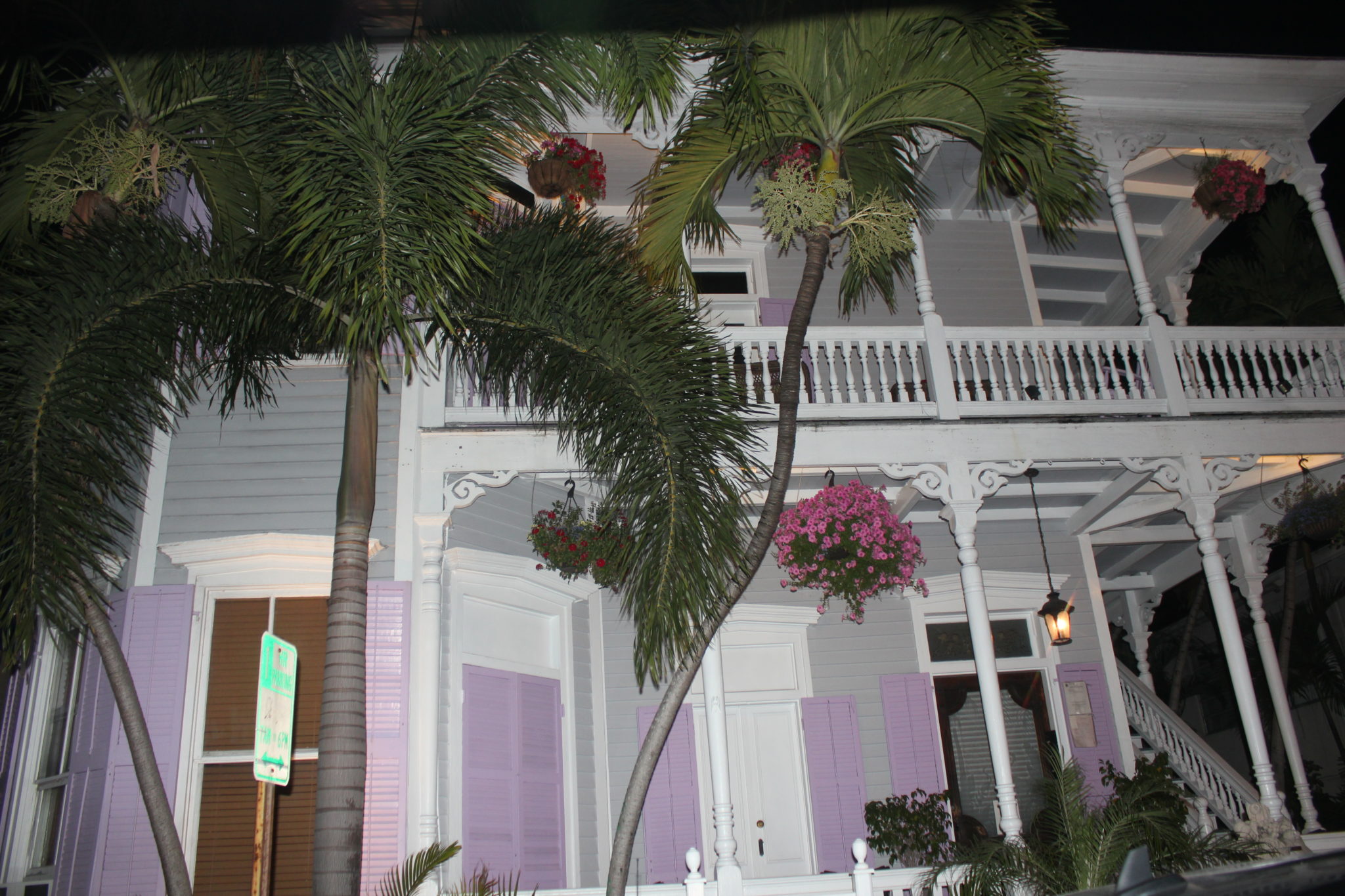
If you’ve wandered through Old Town Key West, there’s a pretty good chance you’ve passed Ridley House at 601 Caroline Street.
Today, it’s part of the Key West Historic Inns collection.
It has everything you want from an Old Town Key West property: beautiful porches, a white picket fence, lush tropical landscaping, and the kind of setting that makes you immediately think:
Yep. I could sit on that porch for a while.
But there’s a lot more happening behind that fence than pretty Key West architecture.
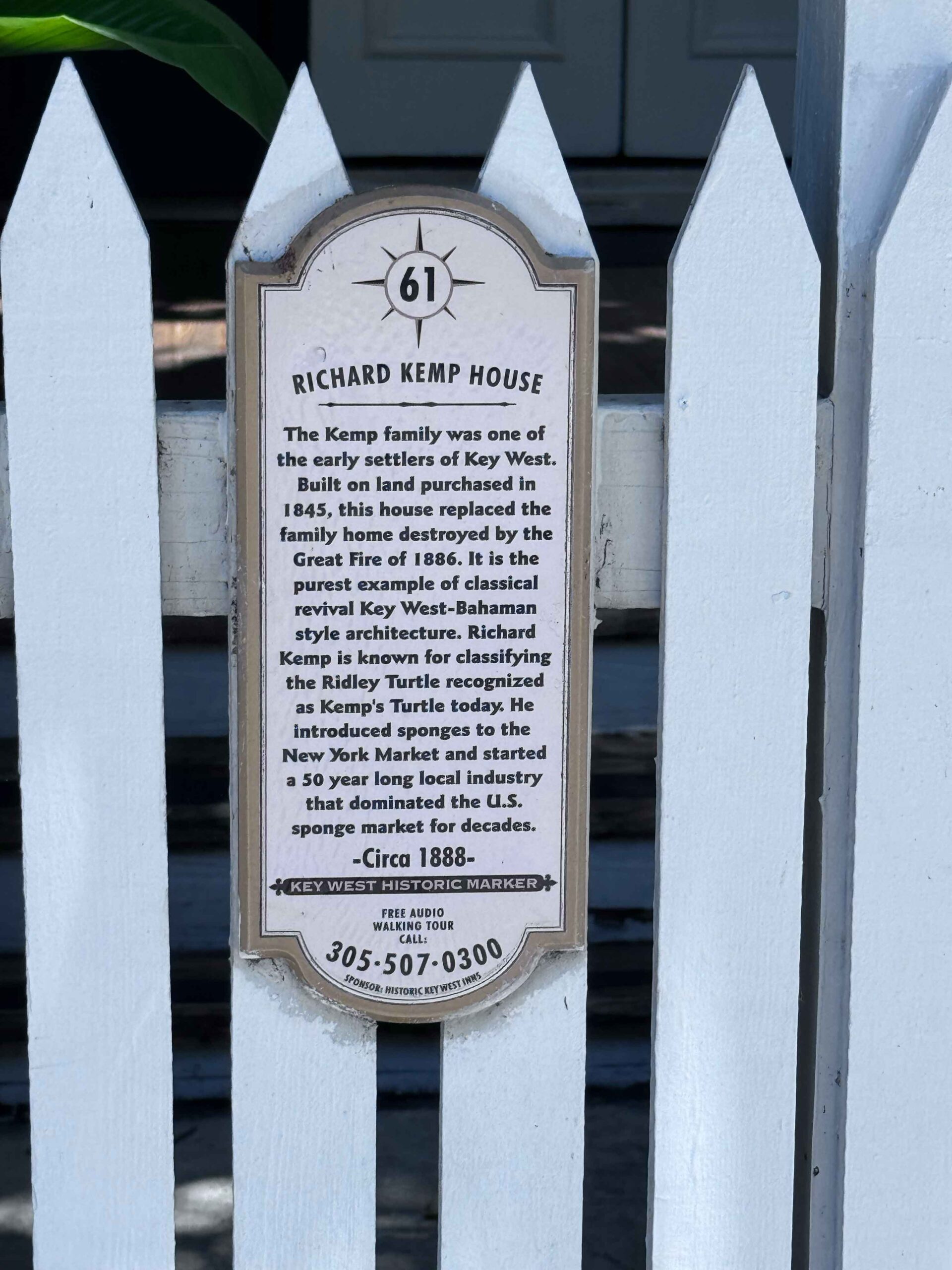
The story of the property goes all the way back to 1845, when the Samuel Kemp family purchased about a quarter of the city block and built their family home there.
The Kemps were part of the early wave of Bahamian settlers who helped shape what we now think of as Old Key West.
And the family remained connected to this property for an incredible 72 years.
Think about what Key West would have looked like during that time.
No cruise ships.
No electric cars buzzing down Duval.
No frozen drinks at Sloppy Joe’s.
And certainly no rooster trying to steal your breakfast sandwich outside Cuban Coffee Queen.
This was a working island filled with fishermen, wreckers, merchants, cigar makers, sponge fishermen, and boats constantly coming and going.
And right in the middle of it was the Kemp family.
Meet Richard Moore Kemp
One of the people growing up in the middle of all this was Richard Moore Kemp.
And Richard was… busy.
He was a merchant.
He sold furniture.
He fished.
He became involved in the sponge business.
And apparently, in his spare time, he was also an amateur naturalist.
Which makes me wonder what this man’s planner looked like.
9:00 am: Furniture business.
Noon: Go fishing.
After lunch: Discover a species.
Because Richard Kemp had a habit of paying attention to the natural world around him, and that curiosity would eventually put his name into biology books around the world.
But before we get to the turtle, we need to talk about something else floating around in the waters off Key West.
Sponges.
Stay with me here.
Richard Kemp and Key West’s Sponge Industry
Long before Florida became known for natural sponges, many of the sponges sold in the United States were imported.
Then people in the Florida Keys realized something rather important:
Hey… we have sponges.
Lots of them.
Historical accounts credit Richard Kemp with helping introduce Key West sponges to the New York market.
And apparently, the first shipment wasn’t exactly an overnight success.
It almost didn’t sell.
Eventually, though, buyers recognized that Florida sponges had commercial value, and an industry began to grow.
By the late 1800s, sponging had become big business in the Keys. Hundreds of vessels worked the sponge beds, and more than 1,000 people were employed in the industry.
So the next time you’re standing at the Key West Historic Seaport looking out over the boats, imagine a very different scene.
Small working boats returning loaded with natural sponges.
Men working from boats with long poles and hooks.
Sponges being sorted, sold, packed, and shipped to markets far beyond the Keys.
An entire economy was coming out of the water surrounding Key West.
And Richard Kemp was there near the beginning of it.
Pretty impressive.
Except sponges still aren’t what made him famous.
Enter the Turtle 🐢
Somewhere around 1880, Richard Kemp encountered a small sea turtle that didn’t quite look like the others.
He became convinced it was different.
Now imagine trying to make this argument in the late 1800s.
Richard: I think this is a different species.
Everyone else: Richard. It’s a turtle.
Richard: No, no, no. It’s a DIFFERENT turtle.
Thankfully, he kept paying attention.
Kemp collected specimens and studied the turtles, and eventually the species was scientifically recognized.
Today, we know it as the Kemp’s ridley sea turtle.
Yep.
Kemp’s, as in Richard Kemp.
The Kemp’s ridley is considered one of the rarest sea turtle species in the world, and it carries the name of this Key West businessman and amateur naturalist.
And this might be my favorite part of the entire story.
This wasn’t Richard Kemp’s profession.
He wasn’t sitting in a university laboratory somewhere studying marine biology.
He was living in Key West, running businesses, fishing, working in the sponge trade, and simply paying attention to the world around him.
Then he noticed something other people hadn’t.
That feels very Key West to me.
So many of the island’s best stories begin with somebody simply noticing something.
Then Key West Burned
By this point, we have a sponge industry and a mystery turtle.
Surely that’s enough for one story.
Nope.
Because this is Key West.
On April 7, 1886, the Great Fire of 1886 swept through the city and destroyed a huge portion of Key West.
The original Kemp family home was among the buildings lost.
Imagine your family having lived on a property since 1845 and suddenly…
Gone.
But the Kemps didn’t leave.
Richard rebuilt.
In 1888, the house we associate with Richard Kemp today was constructed.
And here’s another fun little detail.
A Ship Carpenter Built the House
The man who constructed the Richard Kemp House was a ship carpenter named John Sawyer.
Which actually makes perfect sense when you think about early Key West.
This was an island filled with people who understood ships.
They understood wood.
They understood wind.
And they definitely understood what happens when Mother Nature decides to rearrange your furniture.
Those same skills were used to build many of Key West’s homes.
The Richard Kemp House became a wonderful example of what we now call Key West Bahamian architecture, and the historic marker outside the property describes it as one of the best examples in the historic district.
More than 135 years later, it’s still standing.
Not bad work, Mr. Sawyer.
And if this were a perfectly respectable history article, this is probably where we would wrap things up.
Historic house.
Interesting businessman.
Rare turtle.
The end.
Except…
Of Course There’s a Ghost Story 👻
You knew I couldn’t tell you about an old Key West house without giving you a ghost story.
But I’m putting a giant Key West-sized asterisk next to this part:
This is local legend.
We have officially wandered out of documented history and into the wonderfully fuzzy world of Key West storytelling.
The legend centers around a caretaker often called Mr. Mosby.
According to versions of the story, Mosby was fiercely protective of the property and of a woman in the Kemp family who lived there.
He also supposedly had money.
Quite a bit of it.
And apparently, he didn’t trust banks.
Honestly?
Looking at some of the characters wandering around a 19th-century Key West waterfront, I can understand the hesitation.
The legend says Mosby hid his money somewhere on the property.
Depending on who tells the story, it may have been gold, coins, or cash.
Then he died without revealing its location.
Which means, naturally, people have wondered whether the treasure is still there.
And maybe Mr. Mosby is, too.
Stories have circulated about a figure being seen around the property, almost as if the caretaker decided he wasn’t quite ready to clock out.
Do I know if there’s buried treasure underneath Ridley House?
Absolutely not.
But if somebody is landscaping one day and discovers a coffee can full of 19th-century gold coins, I would just like it noted that we discussed the possibility here first.
And That Brings Us to Ridley House Today
The Richard Kemp property didn’t disappear into Key West history.
It’s still there.
Today, the historic home is known as Ridley House.
And now that name suddenly makes a whole lot more sense, doesn’t it?
Ridley.
As in the Kemp’s ridley sea turtle.
Today, people are sleeping, swimming, eating breakfast, relaxing in the gardens, and sitting on those porches at a property connected to a Key West family whose story began there more than 180 years ago.
I love that.
Because this is exactly why I don’t think exploring Key West history needs to feel like taking a history class.
You don’t need to memorize names and dates.
Just walk a little slower.
Look at the houses.
Read the historic markers.
Wonder who lived there.
And every once in a while ask:
Did I know that?
Because chances are, there’s a really good story hiding behind that picket fence.
Explore More Key West Stories Through Food
Today’s podcast episode is sponsored by Key West Food Tours, and honestly, it’s such a perfect fit for this kind of Key West exploring.
Their tours aren’t simply about eating your way around the island, although obviously that’s a pretty fantastic part of it.
You’ll also learn about Key West neighborhoods, history, people, architecture, and some of those little stories you might otherwise walk right past.
Basically, history is even better when snacks and cocktails are involved.
👉 Learn more and book a Key West Food Tour:
FunInKeyWest.com/FoodTour
Will You Ever Look at Ridley House the Same Way Again?
So here’s my question.
The next time you’re wandering down Caroline Street and pass Ridley House, are you going to simply think:
Pretty house.
Or are you going to look through that white picket fence and think:
Turtle house.
Because I’m pretty sure that’s what I’m calling it forever.
And if you’ve actually stayed at Ridley House, I definitely want to hear about your experience.
Even better…
Did anything happen while you were there that made you wonder whether Mr. Mosby might still be keeping an eye on the place?
Tell me your story!
And if you love discovering the people, places, food, history, and wonderfully quirky details hiding around Key West, make sure you subscribe to the Fun in Key West podcast and share it with another island lover.
Then keep exploring here on FunInKeyWest.com because there are plenty more stories hiding around this little island.
See you in Key West! 🌴🐢